Home / Blog / Neighbour's Tree Hanging Over Your Roof? A Pre-Storm Guide for Delta Homeowners
Storm Prep
When a Neighbour's Tree Hangs Over Your Roof, Fence or Driveway
Woodpro Team · · ~7 min read
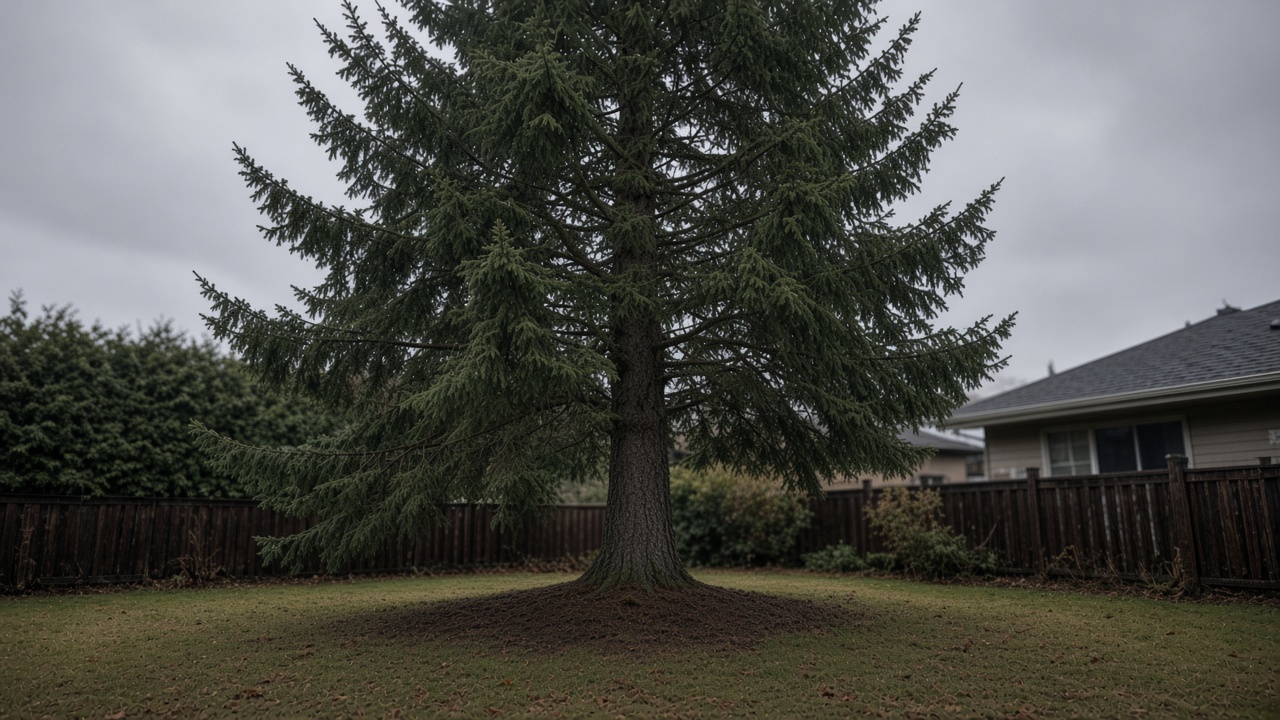
A neighbour's tree over your roof, fence or driveway is a shared problem before Delta's winter storms. What to notice, how to talk, and when an arborist should look.
Every late October in Delta, Ladner and Tsawwassen, the limb you keep watching is rooted past the fence. A neighbour's Douglas fir, western red cedar, hemlock or maple hangs over your shingles, your driveway or the top rail. The trunk is on their lot. In a November or December southeast gale, the roof or the fence on your side is what that wood can hit.
This is not clearance on a tree you own. Branches over your own roof, limbs against a fence or shed and low wood over a driveway are related cuts, and you can book those. A boulevard tree is a different question: who should receive the enquiry. Here the trunk is theirs and the target is yours.
Why the trunk's side of the fence changes the plan
You want the wood over the gutter dealt with. The stem, the roots and most of the crown still stand on their lot. Cutting it because it crosses the line is a poor October plan. Do not assume a neighbour's tree is yours to cut where it crosses the property line. Talk first.
The cut may need a climber on their side and a drop zone on yours. A crew cannot use their yard only because you called. A large limb in a tight side yard often has to come down in sections, so it does not drop onto shingles, a car or the fence. Make that plan while the tree is still standing.
What you can see without crossing the fence
Stay on your lawn. Do not climb the fence, the roof or the tree. A photo from the ground, or from an upstairs window, is enough. None of this is a diagnosis.
Roof and gutter. Wood on the shingles, on the fascia, or in the trough. Leaves and needles pack a gutter faster when a limb sits over it. Photograph both touching and hovering. Wet wood moves.
Driveway and walk. A lateral over the parking spot or the path. August clearance can vanish once the limb is heavy and the wind is up.
Fence. Polished bark, a rail starting to bow, or a limb that will swing into the panel. Say which side the trunk is on. A possible line tree is not the same as a tree set back in their yard. The fence is not a survey.
Deadwood and hangers. Grey wood without fine twigs, or a cracked piece hung over the roof. Do not pull it down.
Cracks and tight forks. A seam in the union over the house, or a split that looks new since summer. Do not probe it.
Lean and the base. A trunk that now tips toward the roof is different from an old lean toward the light. If their soil heaved in an arc after the last rain, mention it. Do not cross the fence to look.
Sail. Douglas fir, western red cedar and hemlock still hold a full crown into the southeast gales. Maple, birch and cherry may be bare after leaf drop. Name the limb over the bedroom, the drive or the fence.
Talking with your neighbour before a saw is booked
Lead with a photo. You share the fence and the storm season.
Show the target. A wide shot, then the limb over the roof, drive or fence. Describe the branch you are watching. Skip "your tree is dangerous."
Ask what they see on the trunk, the flare and the far side of the crown. They may already know about a crack.
Ask for a look before a cut. The answer may be a small clearance prune, a tree to watch, or no work this winter. We will say which.
Settle access. Their yard, a place for wood, and cars under the limb have to be part of the yes. Do not assume the gate opens.
Keep the bill between you. We quote the work. We do not split it or say what they owe. Sort that between your households before a crew is booked, especially for removal.
If you are already stuck. A tree health report describes the tree for both of you. An arborist report is what we write when a city asks. Neither settles a dispute.
Say who decides. Strata council may have to approve common-property work. If you have only reached a tenant, the owner still has to approve a crew.
What to leave alone on a wet afternoon
Do not saw the overhang. A pole saw on soft ground, under wood that can swing onto the roof, is a bad cut.
Do not top the crown to shrink the view from your window. The stubs sprout weakly. The union remains. We do not top, flush-cut or lion-tail a crown by stripping inner wood and leaving tufts at the tips. If a request would do that, we will say so. Useful clearance is tree trimming and pruning back to a sound union.
Do not send a crew over without a clear yes. Tree removal on their stem should not arrive as a surprise.
Do not rope the limb to your fence or the house. You can load the union, and the fence, a new way.
Leave wires alone. If a power or communication line is in the crown, say so and stay back. That is not a homeowner cut, and it is not automatically ours until the span is safe.
Leave City trees alone. Boulevard and park trees go to the municipality. Confirm the owner before anyone cuts.
Bylaws differ, and a handshake is not a permit
This is not legal advice. We will not tell you which limbs you may cut, or how a permit will turn out.
Cities here do not share one tree rule. In Delta, check the Tree Protection and Regulation Bylaw before removing or substantially pruning a private tree, and do not prune or remove City trees. Start at the City of Delta trees page and confirm the current rule with the City. Surrey, Richmond, Burnaby, Vancouver and the rest differ. Use that city's page.
A neighbour's yes gets a crew onto their tree. It does not replace a permit where the city requires one. A permit does not replace their permission. Deadwood is not automatically exempt. If the lot line is unclear, say so.
When an arborist should assess
You can call before both owners agree. Tell us whose tree it appears to be.
There is a target. Roof, gutter, driveway or fence, and storms are the reason you noticed.
Something changed. A new crack, a hanger, a lean missing from last year's photo, or soil at the base that lifted in the rain.
Prune or remove is the open question. A sound stem with one limb on the structure is often a prune. A failing trunk, a lean toward the house, or a clearance cut that would strip the crown is a removal conversation. Photos start it. A visit decides it.
You need a shared description. The note describes the tree. It does not assign cost, blame or the city's answer.
It may need nothing. A sound cedar that already clears the roof can wait until spring. We will tell you.
A visit, and any work after a failure, is schedule- and weather-dependent. Ask before the next gale if the target is obvious. Wood on the lawn is debris removal. Wood still overhead is the assessment.
A neighbour's overhang at a glance
| What you are seeing | What it usually means | Next step |
|---|---|---|
| Their limb on the shingles or in the gutter | Clearance, with their tree in the plan | Photo it; talk before any cut |
| Tips over the driveway, not touching | A target once the wood is wet | Share the photo; skip the pole saw |
| Bowing rail, or bark worn on a panel | Pressure on the shared line | Note which side the trunk is on |
| A crack or hanger over the roof | More urgent than a tidy-up | Stay clear and call |
| Sound tree, well clear of the house | Often no work this winter | Do not top it to feel safer |
| You disagree on the next step | One description is still useful | Assessment, not a legal opinion |
Name the row that fits, and whose lot the trunk is on.
What to ask for when you call
- Whole-tree photo from your side of the fence, trunk included if you can see it.
- Target photo of the roof, gutter, driveway or fence under the limb.
- Defect photo of a crack, hanger, rub or dead stub.
- A summer photo, if you have the same angle.
- Whose tree: their yard, the line, a strata, or unknown, including a possible City tree.
- The conversation: they will look, no reply yet, or you have not asked.
- Access: gate, soft ground, cars, wires.
- The hope: clearance, keep it, or a straight removal answer. Unsure is fine.
The first useful frame holds their tree and your roof together.
Get a plan before the gale decides for both of you
A neighbour's tree over a Delta roof is common. On its own it is not a reason to remove a healthy cedar, and it is not a ladder cut because the line passes under the limb. Look, photograph, talk, and have an arborist say whether this is a prune, a tree to watch, a report, or a removal.
Woodpro crews include ISA-certified arborists, work fully insured, and follow WorkSafe BC practices. We can tell you whether to book this with your neighbour or leave it until spring.
Get a Free Quote, or call (778) 800-6791. You can also email a few photos of their tree and the roof, fence or driveway under it to info@woodpro.ca. We serve Delta, Ladner, Tsawwassen and communities across Metro Vancouver and the Lower Mainland.