Home / Blog / Buying a Home This Fall? What a Pre-Purchase Tree Evaluation Can Tell You in Metro Vancouver
Arborist Reports
Buying a House With Big Trees? What to Check Before Your Subjects Come Off This Fall
Woodpro Team · · ~8 min read
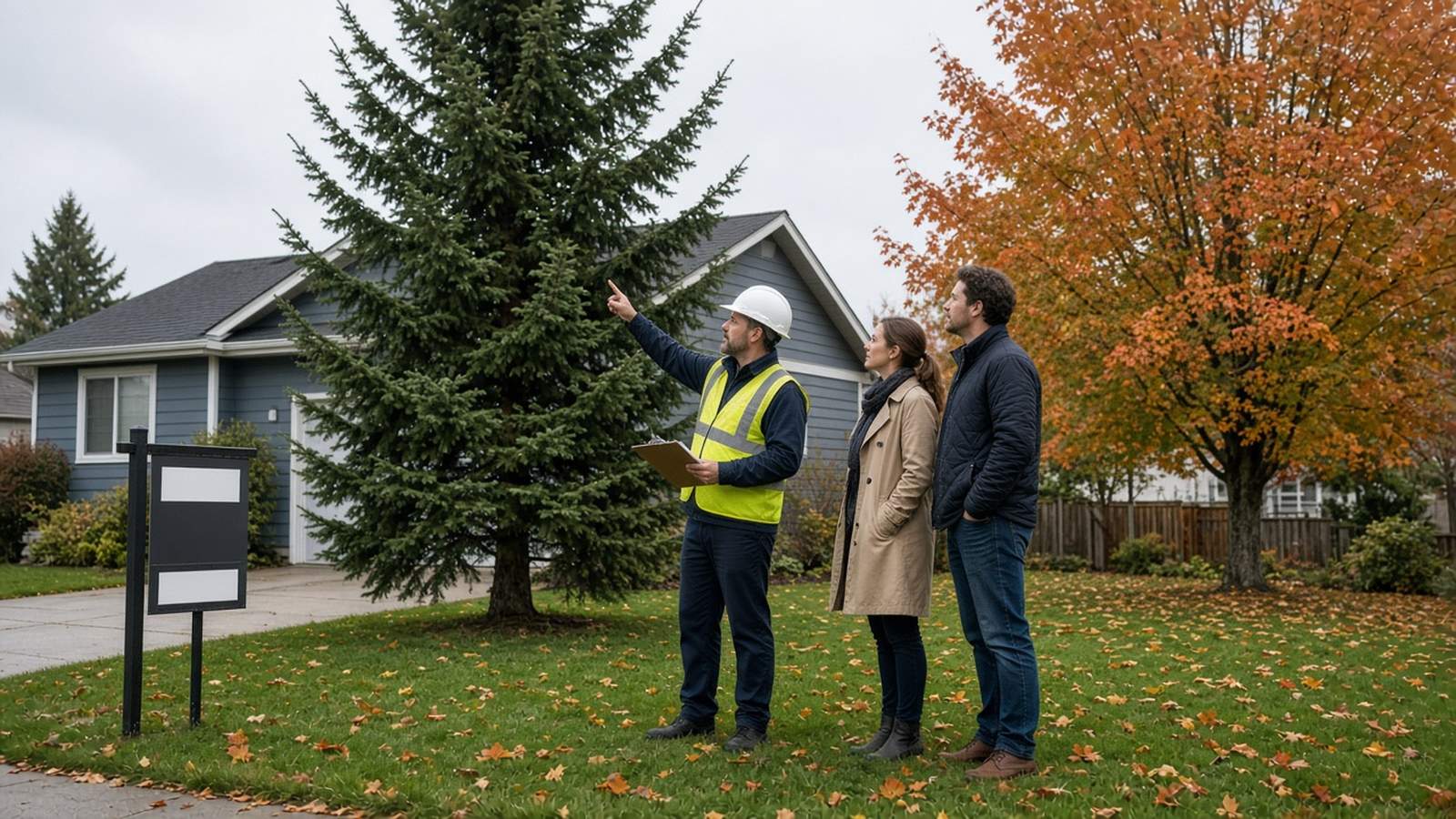
Buying a home with mature trees this fall? See what a pre-purchase tree evaluation checks, what it reveals about storm risk and permits, and when to book it in Metro Vancouver.
Early October is a busy stretch for home buyers in Metro Vancouver, and plenty of the listings come with mature trees: a tall Douglas-fir behind the house, a row of cedars along the fence, a big maple shading the driveway. Those trees are often part of why a property feels special. They can also come with costs and decisions that never show up on the listing sheet.
A home inspector looks at the house. A pre-purchase tree evaluation looks at the trees around it, so you know what you're taking on before your subjects come off, not after the first windstorm of your first winter there.
Why fall is a good time to look at a property's trees
Fall gives you a useful snapshot of a tree's condition, and it lands right before the season when weak trees tend to show themselves.
- Leaves are still on most deciduous trees in early October. Thin crowns, early colour on one side, or dead sections stand out against healthy foliage. Once the leaves drop, some of those clues get harder to read.
- Fall rains bring out fungi. Mushrooms and conks at the base or on the trunk often appear after the first steady rains and can point to decay that's hidden the rest of the year. Our guide to mushrooms at the base of a tree explains what they can mean.
- Storm season is ahead. If a tree has a weak union, a dead top or a worsening lean, you want to know before the wet, windy months, not after you've moved in.
- Calendars are still open. Once the first big storms hit, emergency calls fill schedules across the region. Knowing what a property needs now gives you more choice on timing later.
What a pre-purchase tree evaluation looks at
Woodpro's ISA-certified arborists provide pre-purchase evaluations as part of our arborist reports & permits service, using the same checks behind our tree health assessments. On a typical residential lot, that means looking at:
- Crown condition. Dieback, thinning, deadwood, and broken or hanging limbs.
- Branch architecture. Co-dominant stems, weak unions, and long, heavy limbs reaching over the roof.
- Trunk integrity. Cracks, cavities, seams, old wounds and signs of decay.
- Root zone health. Soil heave, a new lean, root damage from past construction, trenching or paving, and compacted soil.
- Pests and disease. Signs that a tree is in decline, and whether treatment is realistic.
- What each tree could hit. The house, garage, fences, driveway, overhead lines and the neighbour's property.
You get the findings in writing and in plain language: which trees are in good shape, which need work, and which may need to come down. For a buyer, that's the difference between "nice trees" and a clear picture of what you're about to own.
Questions a tree evaluation can help you answer
| Question | What the arborist looks at | Why it matters to a buyer |
|---|---|---|
| Is any tree a near-term risk to the house? | Deadwood, cracks, lean, decay signs, weak unions over the roof | Hazard work may need to happen soon after you move in, especially before winter storms |
| Will this tree need ongoing care? | Crown density, past pruning cuts, clearance over the roof and gutters | Regular pruning becomes part of owning the property |
| Can a struggling tree be saved? | Health, pests and disease, root zone, structure | Some trees respond well to pruning, cabling or treatment; others are past that point |
| Is the tree likely to be protected? | Species, size, location, nearby watercourses | Many municipalities require a permit to remove larger trees, which affects plans and timelines |
| Do neighbour trees affect the lot? | Overhanging limbs, trees on or near the property line | Shared trees usually need a conversation with the neighbour before any work starts |
The permit question most buyers miss
Many buyers assume that once they own a property, they can remove any tree on it. In much of Metro Vancouver, that isn't how it works. Cities including Delta, Surrey and Vancouver regulate the removal of trees above a certain size, and the rules differ from one municipality to the next. Some ask for an arborist report with the application, and some require replacement planting.
That matters most if you're planning changes. A renovation, an addition, a new garage, a wider driveway or a laneway house can all run into a large tree in the wrong spot, and that can change what you can build or how long approval takes. An evaluation flags trees that are likely to be regulated so you can check with the municipality and factor it into your plans before you commit. Our arborist report and permit guide walks through how the process usually works.
Some properties also have covenants registered on title that protect trees or green areas. Your lawyer or notary can confirm what's registered; an arborist can help you understand which trees and areas it likely covers.
Common findings on Metro Vancouver lots
Every property is different, but a few situations come up again and again around the Lower Mainland:
- Tall conifers close to the house. Douglas-firs, western redcedars and hemlocks are everywhere here. Many are perfectly sound. Some have dead tops, old storm damage or root problems that aren't obvious from the ground.
- Trees that were topped years ago. Topping leaves clusters of fast-growing shoots that can be weakly attached and usually need regular attention.
- Limbs over or touching the roof. Usually a pruning job rather than a removal. See our post on roof clearance pruning.
- Big trees with two main stems. Co-dominant stems can sometimes be supported with cable bracing instead of removal. Our cable bracing guide explains when that works.
- Hedges that have outgrown the yard. Overgrown cedar and laurel hedges are common and can mean a sizeable first-year cleanup.
- Old construction damage. Trees near a newer driveway, addition or utility trench sometimes decline years later because of root damage.
None of these automatically means walking away from a home. It means knowing what the trees will need and planning for it.
How to fit it into your subject period
Timing is the tricky part, because subject periods can be short. A few steps help:
- Flag the trees early. If a property has large trees near the house, mention it to your realtor when you're writing the offer, so there's room for a tree evaluation alongside the home inspection.
- Book as soon as your offer is accepted. Send the address, listing photos and access details right away.
- Arrange access. The seller or listing agent will need to let the arborist onto the property, including the backyard.
- Review the findings with your realtor. How the results affect your purchase is a decision for you and your realtor, with clear information in hand.
Already bought? A fall walk-through in your first year is still worth it. You'll head into winter knowing which trees are fine and which need attention.
Buying into a strata? Trees on common property are usually the council's responsibility, so ask whether there's a recent arborist report or maintenance plan. Our strata fall tree checklist shows what a good plan looks like.
What to send when you request a quote
- Address and municipality
- Your subject removal date or overall timeline
- Photos of the larger trees, from listing photos or your own visit
- Anything you noticed, like a lean, mushrooms at the base, cracks or dead branches
- Your plans for the property, such as a renovation, laneway house or new driveway
- Access details for the backyard and side yards
Pricing depends on the number and size of the trees, the kind of report you need and the site itself, so the fastest way to a clear number is to request a free quote.
One company from evaluation to tree work
If the evaluation turns up work, Woodpro can carry it through: tree trimming & pruning, cable bracing, tree removal with the permit process handled, and full cleanup. The arborist who assessed the trees and the crew doing the work stay on the same page from start to finish. Woodpro crews include ISA-certified arborists, work fully insured, and follow WorkSafe BC practices.
Buying a home with mature trees this fall?
Find out what the trees will need before your subjects come off, while there's still time to plan around storm season.
Get a Free Quote, or call (778) 800-6791. You can also email the listing link and a few photos to info@woodpro.ca.
Woodpro Tree Services is based in Delta BC (North Delta, South Delta & Ladner) and serves Metro Vancouver and the Lower Mainland with arborist reports & permits, tree health assessments, tree removal and tree trimming & pruning. Scheduling depends on weather, access, and the current calendar.