Home / Blog / Cable Bracing Before Storm Season: When Weak Unions Need Support in Metro Vancouver
Cable Bracing
Cable Bracing Before Storm Season: When Weak Unions Need Support in Metro Vancouver
Woodpro Team · · ~7 min read
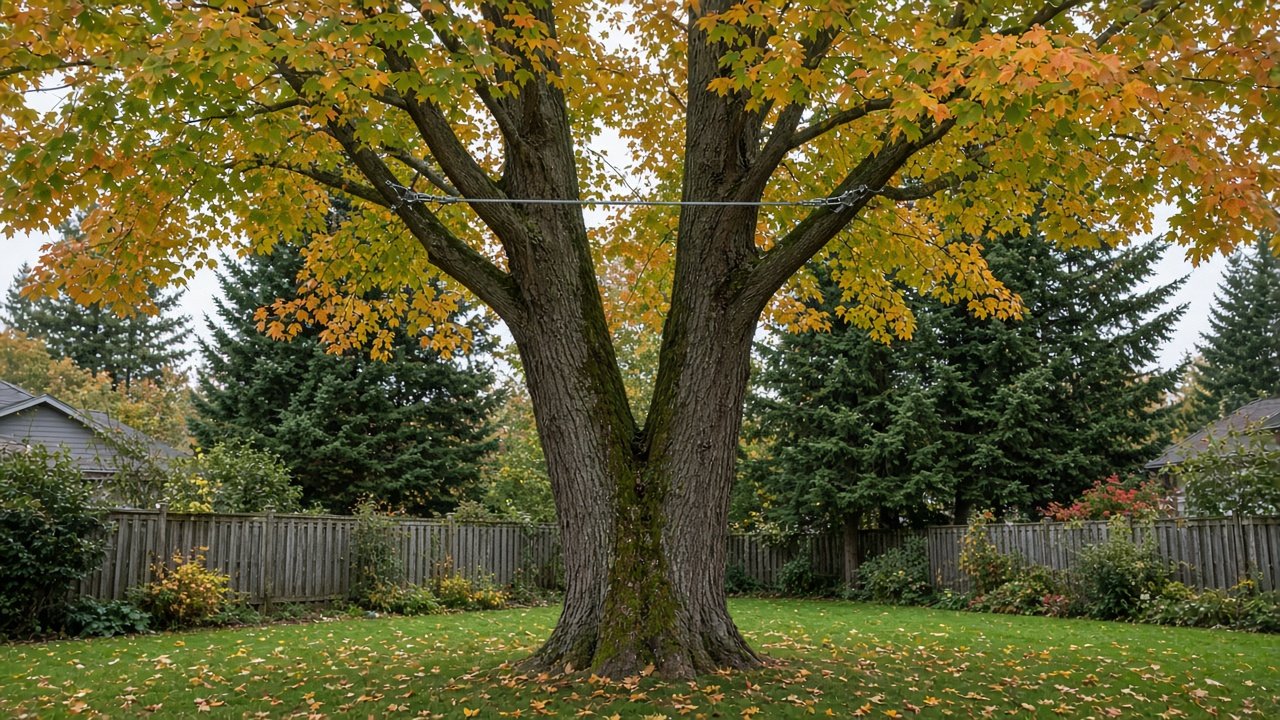
Co-dominant stems or weak unions before Metro Vancouver storms? When cable bracing helps, when removal is safer, and how to get a free quote from a Delta arborist crew.
Fall Pacific wind and rain load every weak fork in the canopy. For some trees, the right move is deadwood cleanup or removal. For others — mature shade trees, street-facing specimens, or a heritage tree the property was built around — the better question is whether cable bracing can give the structure the support it needs to stay.
Woodpro Tree Services is based in Delta BC (North Delta, South Delta & Ladner) and works across Metro Vancouver / the Lower Mainland. This guide is a decision framework for when cable bracing helps trees with co-dominant stems or weak unions, when pruning or removal is safer, and what to gather for a free quote.
Related fall reading (different jobs): storm prep / deadwood, post-storm debris, stump grinding, and arborist reports & permits. Here we stay on structural support for trees worth keeping.
Why fall is the right window for a bracing conversation
Metro Vancouver’s wet season is when wind finds every included bark seam and heavy lateral limb. Sorting support before the heaviest storm window means the tree is assessed while access is still workable and while you still have options short of emergency take-down.
Practical fall reasons to assess bracing now:
- Wind loads rise with rain-soaked canopies — weak unions fail more often once foliage and wood are wet
- Trees you want to keep — bracing is a retention tool, not a cleanup after failure
- Strata and heritage trees — boards often prefer support over removal when the tree still has a safe service life
- Existing cables need a check — older systems stretch, corrode, or get buried in growth before winter
Fall urgency here is about support and retention planning, not waiting for a stem to split in the first big blow.
What cable bracing actually does
Cable bracing (tree cabling) adds a designed support system so structurally weak trees gain stability and a lower risk of catastrophic failure. Woodpro uses high-strength steel cables and, where appropriate, threaded rod braces to redistribute load through a safer path in the tree.
Two common approaches on the service page:
- Static cabling systems — fixed support for unions and stems that need firm restraint
- Dynamic cabling systems — more flexible support that allows controlled movement while still limiting extreme swing
A proper install is more than hanging a wire between two leaders. It typically includes a structural assessment, hardware sized for growth, and a plan for inspection and re-tensioning. Cabling is a long-term structural management strategy, not a one-and-done permanent fix — trees keep growing, cables stretch, and hardware ages.
When bracing helps (trees worth keeping)
Bracing is often the preferred alternative to removal when the tree still has value and enough sound wood to work with.
Good candidates often include:
- Co-dominant stems — two (or more) leaders of similar size sharing a tight, weak union
- Weak branch unions — included bark, V-shaped forks, or unions that have already shown movement
- Heavy or over-extended limbs — laterals that load a weak attachment over a roof, driveway, or play area
- Mature or heritage trees — high-value trees worth preserving when removal would be a last resort
If the tree shades the house, defines the lot, or sits under a strata retention preference, ask whether support is on the table before you assume the saw is the only answer.
When pruning or removal is the safer call
Bracing is not a rescue for every defect. An honest assessment sometimes ends with “support won’t make this tree safe enough.”
Leaning toward pruning or removal when:
- Decay or cracks are too advanced — little sound fibre left at the union or in the stem
- Targets are high and failure would be severe — house, playground, driveway, or power lines with no workable support design
- The tree is largely dead or in steep decline — see our deadwood / hazard guide
- A targeted prune solves the load — reducing sail area may be cleaner than hardware; start with tree trimming and pruning
- Removal is already the right end state — and you need the permit / report path before work starts
On a free assessment, Woodpro will say clearly whether cable bracing is the right solution — or whether another approach makes more sense.
Brace, prune, or remove — a simple decision frame
Use this sequence when you walk the yard this fall:
- Value — Is this a tree you (or the strata) want to keep if it can be made safer?
- Defect — Co-dominant stem, weak union, over-extended limb, or storm split?
- Targets — What would it hit if it failed (roof, kids’ area, car, neighbour)?
- Health — Enough live crown and sound wood, or mostly deadwood and decline?
- Options — Support with cable bracing, reduce load with pruning, document with a tree health report, or plan tree removal when retention is not safe.
Many properties end up with a combined plan: prune deadwood, cable a weak union, and schedule re-inspection — rather than all-or-nothing removal on day one.
Inspection and re-tensioning (existing cables count too)
If cables are already in the tree, fall is a smart time to have them checked. Cables stretch and lose tension, hardware can corrode or become included in bark, and the tree’s structure changes after growth or pruning.
Woodpro’s installs are planned with scheduled re-inspection intervals. Exact timing depends on the tree, hardware, and site — ask for a re-inspection schedule on your quote rather than assuming a set-and-forget install. DIY cable bracing is a hard no: wrong placement, hardware, or tension can increase failure risk.
Homeowner and strata angles before storm season
Homeowners often notice a dual leader over the roof or a deep V-fork after summer growth. Photos of the full tree, the union up close, and the target zone are enough to start a quote conversation.
Strata and property managers often need a clear recommendation: retain with support, prune, or remove. A tree health report can help boards decide before winter winds force an emergency call. If removal is the path, see the arborist report and permit guidance for your municipality.
What to prep for a free quote
Before you request a free quote, gather:
- Address and municipality (Delta home base; crews work across Metro Vancouver / the Lower Mainland)
- Photos of the full tree, the weak union or co-dominant stems, and what sits under the canopy
- Whether cables already exist — and any prior install notes you have
- Your goal — keep the tree if possible, reduce risk over a target, or compare support vs removal
- Access notes — gates, slopes, parking, overhead lines, neighbours’ shared canopies
- Strata / board context if approvals or written recommendations are needed
Pricing depends on tree size, number of cables, climbing access, hardware, and whether pruning or other work is bundled — use the free quote rather than guessing from a neighbour’s job.
Woodpro crews include ISA-certified arborists, work fully insured, and follow WorkSafe BC practices. Scheduling depends on weather, access, and the current calendar.
Quick FAQ
Is cable bracing a permanent fix?
No. It is a long-term management strategy. Trees grow, cables stretch, and hardware ages. Plan on regular inspection and re-tensioning so the system keeps doing its job.
Will cabling harm a healthy tree?
Properly installed systems follow practices that minimise wound size and account for growth. The point is to prevent a catastrophic split — which is far more damaging than correctly placed hardware.
Can bracing save a cracked or split tree?
Sometimes — it depends on species, how much live wood remains connected, and the targets below. An on-site assessment is the honest answer; some splits belong in the removal column.
Should I install cables myself?
No. Incorrect placement or tension can make failure more likely. This is certified arborist work with the right hardware and climbing setup.
Ready to support the trees you want to keep this fall?
If a co-dominant stem, weak union, or aging cable system is on your fall list — and you would rather retain the tree than wait for storm failure — get a site-specific plan while access is still workable.
Get a Free Quote — or call (778) 800-6791. Email info@woodpro.ca if that is easier for strata boards and photo attachments.
Woodpro Tree Services serves Delta BC (North Delta, South Delta & Ladner) and across Metro Vancouver / the Lower Mainland — cable bracing, tree trimming and pruning, tree removal, and tree health reports. Crews typically work Mon–Sun 8am–8pm, depending on schedule and weather.