Home / Blog / Strata Council Fall Tree Checklist: Hazard Trees, Hedges and Storm Prep for Shared Property in Metro Vancouver
Strata & Property Management
A Fall Tree Checklist for Strata Councils and Property Managers Before Storm Season
Woodpro Team · · ~7 min read
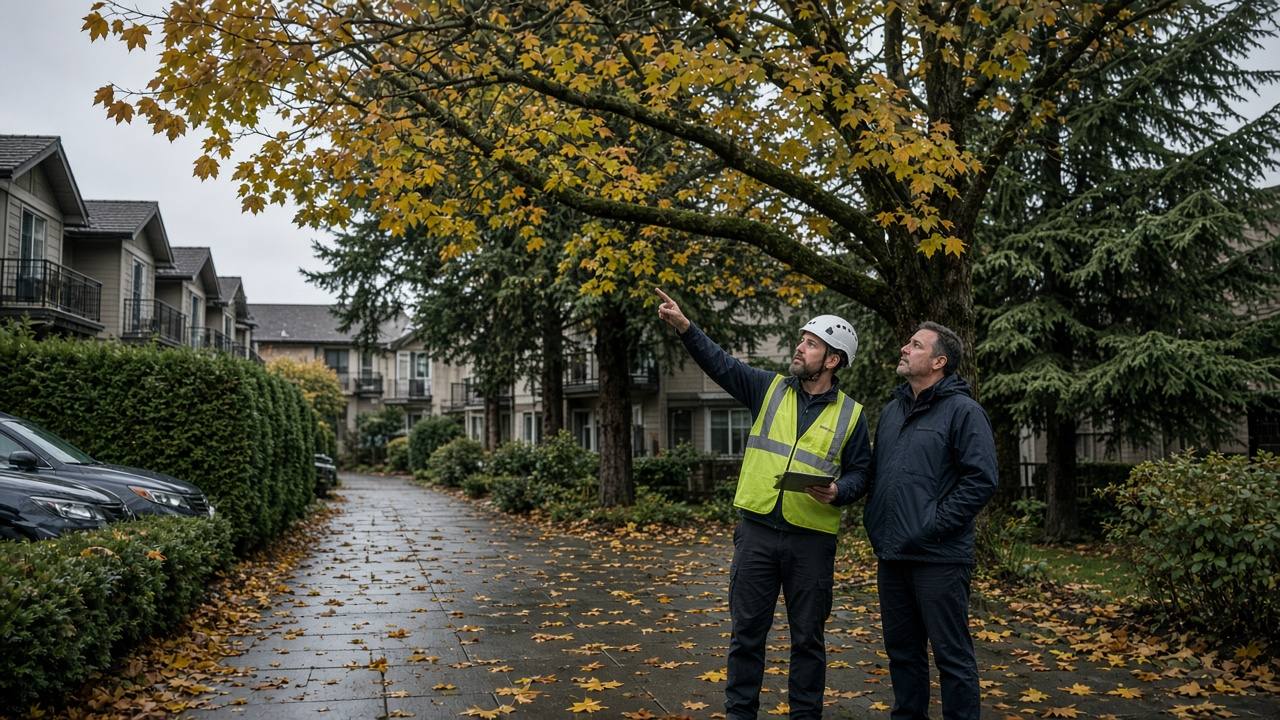
Strata council or property manager? Use this fall tree checklist to walk common property, document hazard trees, plan permits and lock in storm-season tree care across Metro Vancouver.
Every fall, strata councils across Metro Vancouver get the same email after the first big wind: a branch on someone's car, a cedar hedge leaning into the visitor parking, a tree "that's been looking bad for a while" by the playground. The fix is almost always cheaper and calmer when it happens before the storms, not after them.
This checklist is written for strata councils, property managers and building committees who look after shared trees. It walks you through what to look at, what to document, what usually needs a permit, and how to turn a one-time cleanup into a plan your council can actually approve.
Why fall is the window for strata trees
Metro Vancouver's wet season brings saturated soil, gusty fronts off the water and heavy, wet leaf loads on deciduous trees that haven't dropped yet. That combination is when weak limbs, dead tops and poorly anchored trees tend to fail.
For a strata, timing matters for a second reason: decisions take longer. A council may need a quorum, a quote comparison, sometimes an owner vote, and in many municipalities a permit before a protected tree can come down. If you start in October, there is still time to get through that process before the worst of winter. If you start after a tree has already failed, you are making decisions in a hurry with residents watching.
Step 1: Walk the common property with a map
Before you call anyone, do a simple walk-through with a site plan or even a printed screenshot of the property. Number every significant tree and hedge line. For each one, note:
- Location and what's underneath it. Parking stalls, walkways, play areas, roofs, balconies, fences and the property line.
- Obvious dead or broken wood. Dead branches, hanging limbs, dead tops, or bark falling away in sheets.
- Lean or lift. A tree that has started to lean more, or soil and pavement that has heaved or cracked near the base.
- Fungi and decay signs. Mushrooms at the base, soft or hollow-sounding wood, cavities.
- Clearance problems. Branches on roofs, gutters, siding or over driveways where trucks pass.
- Overgrown hedges. Cedar or laurel hedges that have widened into walkways or blocked sightlines at exits.
Take a photo of each numbered item and note the date. You are not diagnosing anything here. You are building a list a certified arborist can work through efficiently, and a record your council can point back to later.
If you spot a limb that is already cracked or hanging, don't wait for the rest of the walk-through. Tape the area off and call for that one first. Our post on hanging and broken limbs explains why those can't sit until spring.
Step 2: Get a professional assessment and a written report
A council member's eye is a good start, but councils need something they can stand behind. That's where an ISA-certified arborist's assessment comes in.
At Woodpro, our ISA-certified arborists provide arborist reports, risk assessments and permit applications that strata councils can present at AGMs and city offices. For trees where the question is health rather than immediate risk, a tree health report helps the council decide whether to treat, prune, monitor or remove.
A useful report for a strata should give you:
- A priority ranking. What needs attention now, what can be scheduled, and what just needs monitoring.
- A recommended action for each tree. Prune, reduce, cable, remove, or leave and re-check.
- Permit flags. Which items are likely to need municipal approval before work starts.
- Plain-language reasons. So owners who weren't on the walk-through understand why money is being spent.
That written record is also your paper trail. If an owner disputes a removal, or a tree fails later, the council can show it acted on professional advice.
Step 3: Sort the work into a council-friendly plan
Most strata properties end up with a mix of urgent and routine items. Splitting them makes approval easier and keeps the budget conversation honest.
| Priority | Typical items | Usual service | When to schedule |
|---|---|---|---|
| Urgent | Hanging or cracked limbs over walkways or parking, dead tops, trees with a new or worsening lean | Tree removal or targeted pruning | As soon as possible, before the next wind event |
| Fall priority | Deadwood over roofs and stalls, roof and gutter clearance, weak unions on large trees | Tree trimming & pruning, cable bracing | October to early November |
| Seasonal | Cedar and laurel hedges widening into paths and sightlines | Hedge trimming | Early fall shape-up, then a regular program |
| Monitor | Healthy trees with minor issues, trees with early decay signs | Re-inspection or tree health report | Re-check after winter storms or in spring |
Urgent items rarely need a long debate. Seasonal and monitor items are where a maintenance plan saves the council from re-deciding the same things every year.
Step 4: Handle permits before the crew is booked
Many Metro Vancouver municipalities protect trees above a certain size, and rules differ from city to city. Some also protect hedges or trees near watercourses. A strata can't assume that because a tree is on common property, the council alone can approve removing it.
The safest order is:
- Arborist assessment and report.
- Permit application where required, using that report.
- Council approval (and an owner vote if your bylaws require one for the spend).
- Scheduling the work.
Our arborist report and permit guide goes deeper on how that process tends to work. Genuine emergencies, like a tree already failing onto a building, are usually handled differently, but councils should still document everything with photos and keep the arborist's notes.
Step 5: Plan for residents on work day
Strata tree work goes smoothly when residents know what's coming. A few things help:
- Notice in advance. Tell owners and tenants which areas will be closed and when.
- Clear the drop zones. Ask residents to move cars out of stalls under the work area, and keep kids and pets away.
- Confirm access. Gate codes, parking for the crew's truck and chipper, and any areas that are off limits.
- Ask about cleanup. At Woodpro, full cleanup is included and we haul the debris away, so common areas aren't left with piles of branches. If your property also has storm debris from earlier in the season, our debris removal service can be folded into the same visit.
Councils should also confirm insurance before any crew works on common property. Woodpro carries commercial liability and WCB coverage on every job, and we're happy to provide documentation for your records.
Step 6: Turn it into a yearly maintenance plan
The councils that have the fewest storm-season surprises are the ones that stop treating trees as one-off emergencies. A scheduled plan, built around seasonal pruning, hazard inspections and hedge maintenance, means problems get caught early and the budget is predictable from year to year.
A simple yearly rhythm for most Lower Mainland strata properties looks like this:
- Fall: hazard walk-through, deadwood and clearance pruning, hedge shape-up, storm prep.
- Winter: storm response and post-storm checks on the trees flagged in fall. See our guide to post-storm cleanup.
- Spring: structural pruning, stump grinding after any winter removals, and re-checks on monitored trees.
- Summer: hedge maintenance, canopy thinning where needed, and planning next year's budget.
Woodpro's strata maintenance plans include storm-response priority, so when a big wind does hit, properties already on a plan are on our list.
Common mistakes councils make
- Waiting for complaints. The first resident complaint often comes after the damage.
- Approving removals without a report. That invites disputes from owners and problems with the city.
- Splitting one site across too many contractors. It makes the paper trail harder to follow.
- Forgetting the hedges. Overgrown hedges block sightlines at driveways and walkways, which is a safety issue as much as a looks issue. Our fall cedar hedge guide covers timing.
- Doing it all in one panic visit after a storm. That's usually the most stressful and least organized way to spend the money.
Get your strata's trees ready before the storms
Woodpro works with strata corporations and property managers across Delta, Surrey and Metro Vancouver. Our ISA-certified arborists can walk your property, give your council a written report it can present with confidence, and set up a maintenance plan that fits your site and budget.
Every property is different, so pricing depends on the number of trees, their size and condition, access, and whether permits are needed. The quickest way to get real numbers is an on-site estimate.
Request a Strata Quote or call us at (778) 800-6791. You can also email info@woodpro.ca with your property address and a few photos, and we'll follow up.