Home / Blog / Brown Needles Inside Your Cedar or Pine This Fall? Normal Drop or a Problem in Delta
Tree Health
Inner Brown Foliage on Cedars, Pines and Fir: What to Check Before Winter Storms
Woodpro Team · · ~7 min read
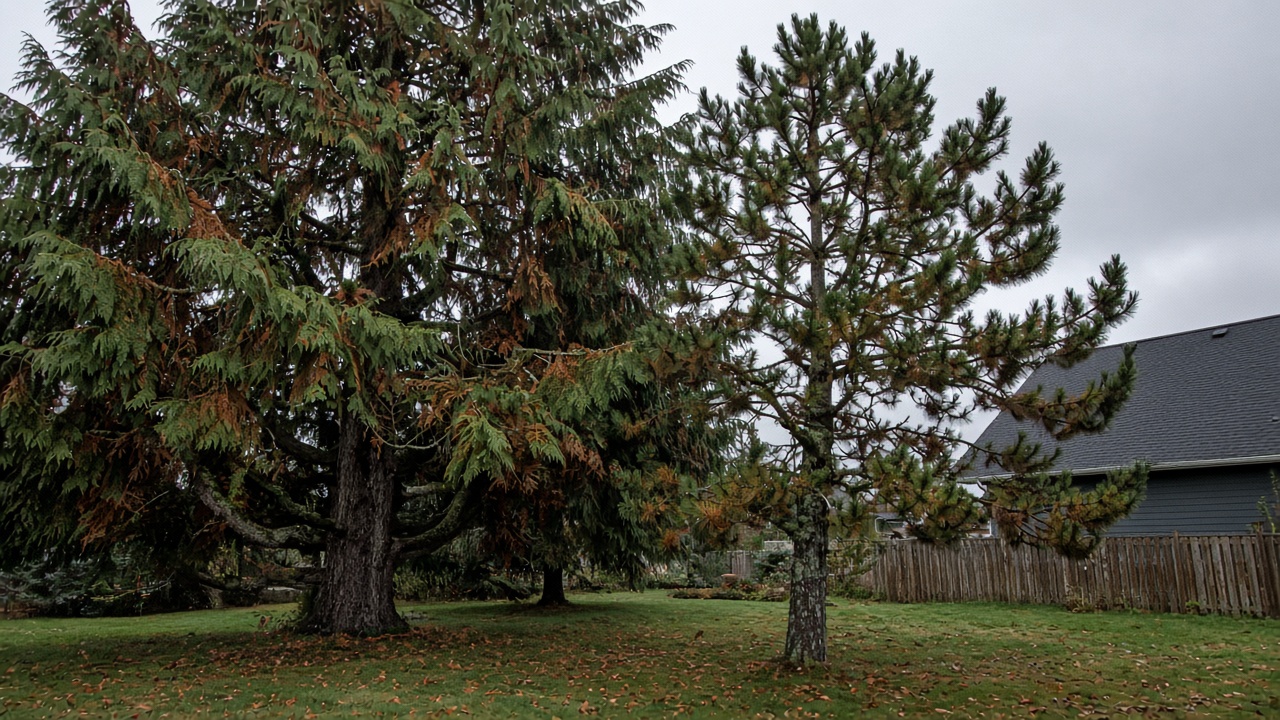
Brown needles deep inside a cedar, pine or fir are often the normal fall shed of older foliage. Here is how that pattern differs from drought stress, disease or decline in Delta.
Every October we get the same call from Delta, Ladner and Tsawwassen. Someone looks into a western red cedar, a pine by the drive, or a Douglas fir and sees brown inside the green. Needles carpet the lawn. After a hot summer it is easy to think the tree is dying, and the November southeast gales are next.
Brown deep inside the crown is often the normal fall shed of older growth, with the tips still green. A brown patch on the outside of a hedge is a different pattern, covered in brown patches in a cedar this fall. This note is the ground check for that interior colour, and for when an arborist should see the tree before winter storms.
Why the inside of a conifer turns brown in fall
Evergreen does not mean every needle stays forever. Cedars, pines, Douglas fir and western hemlock grow new foliage at the tips and let the oldest interior growth go.
Pines show it most clearly. The oldest needles, closest to the trunk, yellow and then brown. New growth at the tip stays green. Trust the location: inside and older, not at the tip.
Cedars shed oldest branchlets, not a whole face. Interior sprays loosen, yellow and drop. The Province of British Columbia describes cedar flagging — isolated branchlets turning yellow or red after a hot, dry summer — as normal for western redcedar and not harmful to growth. Read BC's note on cedar flagging. That page does not diagnose your hedge, pine or fir, or the weather in your yard. Brown inside a sheared cedar is often shade, not a reason to cut to bare wood. A light outer shape, if one is due, stays in green growth: hedge trimming.
Fir and hemlock are quieter. Interior needles fade. The outer shell stays green. A heavy shed can be seasonal, or it can be heat, drought or root trouble. Green tips are reassuring. Brown tips, or one whole limb, are not.
What a normal fall shed looks like from the lawn
Stay on the ground. Part a low branch if you can reach it. Do not climb into the crown.
The tips are still green. This year's growth is intact. The brown starts behind it, toward the trunk.
The colour runs through the inner crown, not along one limb and not only at the top. A pine often yellows in bands of older needles. A cedar shows scattered older branchlets inside a green shell.
It fits the season. You noticed it in September or October, and a similar tree nearby looks the same.
The brown foliage loosens. Wind and rain drop it on the lawn. That is not, by itself, a dying tree.
The trunk and the lean are unchanged. No new crack, no fresh lean, no shelf of fungi at the flare.
If that is the whole picture, photograph it and leave the live crown alone. We will tell you when a visit would not change the plan.
Warning signs that are not a seasonal shed
Seasonal drop starts inside and leaves the tips green. Trouble often does the reverse, or it kills a shoot, a limb, a side or the top.
Brown tips, with green still inside. The newest growth died. Drought, damaged roots, road salt, a pest or a disease can all look like that, and a photo will not name which.
A whole limb brown out to the tip. This year's wood on that limb is dead. Over a roof, a walk, a play area or the drive, it belongs with deadwood and hazard limbs before the storms. Do not pull it down.
The top is dying back. The leader is brown or bare and the lower crown is still green.
One side only. The face against a hot wall, over a new patio, or above a cut root can brown while the rest looks fine.
A fast change. Tips that were green two weeks ago are red-brown on the outside now. Fall shed is gradual and interior.
Brown on the outer face of a cedar hedge. That can be ordinary flagging, or it can resemble cedar leaf blight. Record it before a hard trim or a removal.
A structural clue in the same view. A crack, bark pinched in a tight V, conks on the flare, lifting soil, or a lean that is new since June. The wider look is a fall tree health assessment.
What a dry summer can add
A long dry stretch does two things that look alike from the sidewalk.
One is a heavier normal shed. Older foliage drops, tips stay green, and the crown looks thinner than it did in May.
The other is stress. Roots under a parking strip, pavement or a foundation run short of water. New growth is short, tips brown, and lower limbs die and stay dead.
Note what you know: whether the roots were watered or only the lawn, any digging or paving, and whether the shrubs beside the tree browned too. Weather damage often shows on more than one kind of plant. Many diseases stay with one host. That is a clue to pass on, not a diagnosis, and not a rainfall figure for your street.
What not to do before the storms
Do not shear the brown out of the inside. On cedar, bare wood does not sprout a new green face.
Do not top the tree because it looks thin inside. Taking the top off does not refill it. If height is the concern, ask about crown reduction rather than topping. We do not top, flush-cut or lion-tail. If that is the request, we will say so.
Do not strip the inner twigs. Foliage left only at the tips makes a limb whip. The shed already took the oldest growth.
Do not book removal for interior colour alone. Green tips usually mean a tree to keep. Tree removal is for a tree that is failing, dead, or too hazardous over a target.
Do not climb. After the clocks fall back on November 1, look in the morning, from the ground.
When an arborist should look before winter
Call while the tree is still standing. If a limb has already failed, response is schedule- and weather-dependent.
Dead wood over a target. A brown limb, not just brown needles, sits over the roof, a play area, the drive or the neighbour's side. That is tree trimming and pruning, or removal if the stem itself is the problem.
The pattern is not interior. Brown tips, a dead leader, one side or whole limbs are a different problem. A tree health report or a site look is the right ask.
You cannot see the top. Send a photo of the whole crown.
Roots are about to be cut. A trench, patio or grade change beside a conifer goes on the plan before the machine arrives.
A permit or a strata is involved. Needle drop is not permission to remove a tree, and not a reason to prune a City tree yourself. Bylaws vary from city to city. In Delta, read the current rule on the City of Delta trees page before a private removal, and leave boulevard trees alone. If a report is required, that is arborist reports and permits. We write the report. We do not predict the outcome.
Interior browning at a glance
| What you see | What it usually means | What to do before winter |
|---|---|---|
| Oldest interior foliage brown, tips green | Often the normal fall shed | Photograph it and leave the live crown |
| Heavier interior shed, outer shell still green | Often seasonal; sometimes early stress | Note watering and digging; ask if it stands over a roof |
| Brown tips, or this year's growth dead | Not a normal shed | Have an arborist look |
| One whole limb or the top brown | Dead wood or decline | Stay clear and assess before the gales |
| Brown on the outer face of a cedar hedge | A different pattern | Record it before a trim or a removal |
| Crack, conk, new lean, or lifting soil | A structural question | Call; the needles are not the issue |
What to ask for when you call
- The whole tree, top and house or fence in the frame.
- A reachable low branch, brown interior and green tip in one shot.
- Any limb brown to the tip, or a thin top, photographed from the lawn.
- The base: flare, soil, mushrooms, cracks or a new lean.
- The history: "cedar" or "pine" unless you know the species, when the colour started, whether the roots were watered, any digging or paving.
- Where it stands: roof, drive, play area, a strata lot, or a City tree in Delta, Ladner, Tsawwassen or North Delta.
Get a clearer read before the winter storms
Brown inside a cedar, pine, fir or hemlock, with green tips, is often the ordinary fall shed. Brown tips, a dead limb over the roof, or a thinning top should be sorted out before the gales load a wet crown. If you are between the two, send the photos. We would rather leave a sound tree alone than let a dry-summer decline sit until November.
Woodpro crews include ISA-certified arborists, work fully insured, and follow WorkSafe BC practices.
Get a Free Quote, or call (778) 800-6791. You can also email a few photos of the whole crown and a close view of the inner foliage to info@woodpro.ca. We serve Delta, Ladner, Tsawwassen and communities across Metro Vancouver and the Lower Mainland.