Home / Blog / Thinking of Topping a Tall Tree Before Storm Season? Why Crown Reduction Is the Safer Fall Fix in Metro Vancouver
Tree Trimming & Pruning
Topping vs Crown Reduction: What Actually Makes a Tall Tree Safer Before Metro Vancouver Storms
Woodpro Team · · ~7 min read
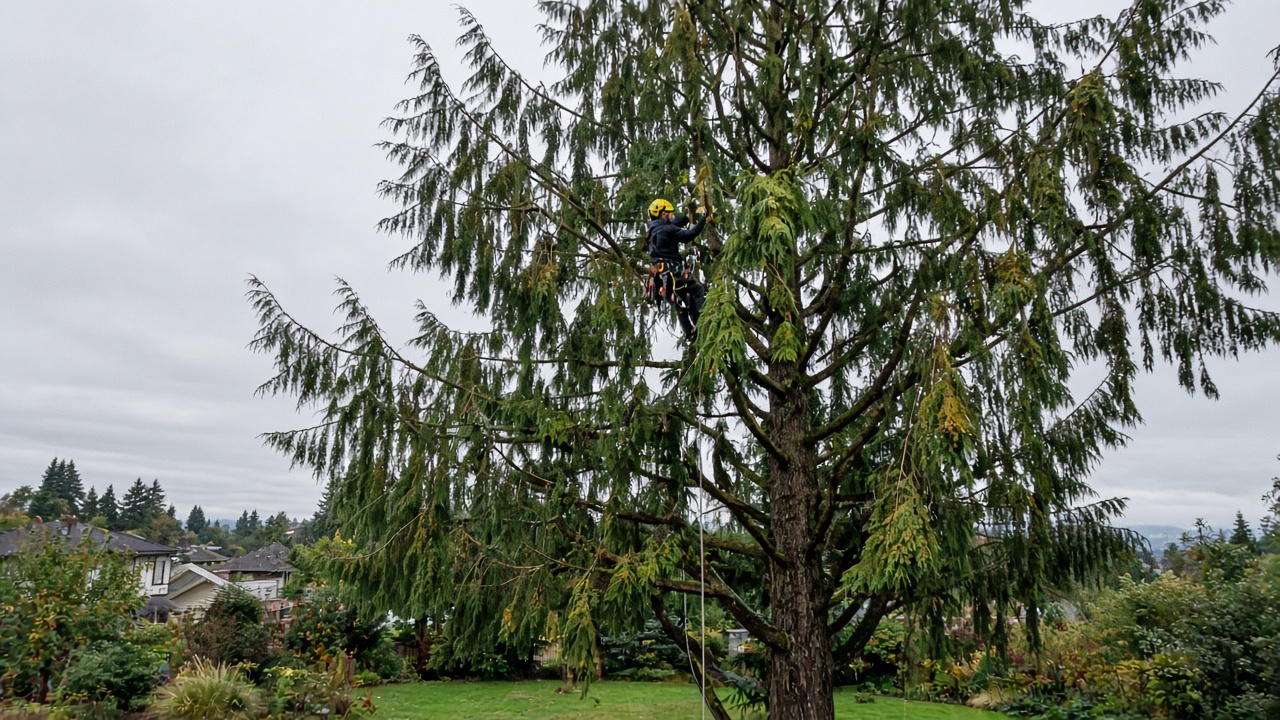
Worried a tall tree will fail in fall storms? Why topping makes trees weaker and how crown reduction lowers wind risk in Metro Vancouver and Delta.
Every October we get the same call from homeowners across Delta, Surrey, Burnaby and the rest of Metro Vancouver: "That tree is getting too tall. Can you just take the top off before the storms?" It is an honest question. A big Douglas fir, cedar or maple swaying over the house in a southeast gale is unnerving, and cutting it shorter feels like the obvious fix.
The problem is that topping usually makes a tree more dangerous over the next few years, not less. There is a better way to bring height and wind load down, and fall is a good time to plan it. Here is how to tell the difference and what to ask for.
What topping actually is
Topping means cutting the main stem or large limbs straight across at a set height, leaving stubs with no living branch to take over. You will also hear it called heading, hat-racking or "rounding over." It is quick, and from the street it can look tidy for a season.
That is why our pruning standards rule it out. Our arborists follow sound industry pruning practice, which means no flush cuts, no topping and no lion-tailing. Those practices permanently damage a tree's structure and long-term health.
Why a topped tree becomes a bigger storm risk
Weakly attached regrowth. A topped tree responds by pushing out a cluster of fast, upright shoots just below each cut. Those shoots grow from the outer layers of wood instead of being anchored deep in the stem, so they are far easier to tear out in wind. Within a few years you can end up with several heavy new tops, each one attached worse than the original leader.
Decay at the cut. A large stub cannot seal over the way a well-placed pruning cut does. In our wet climate, fungi move into exposed wood quickly. Decay can work down into the stem behind the regrowth, which is exactly where you do not want hidden weakness when the ground is soaked and the wind picks up.
Multiple competing leaders. Conifers like Douglas fir, western red cedar and hemlock often send up two or more new leaders after topping. Those co-dominant stems can form weak unions that split under load, the same problem we covered in our post on cable bracing weak unions before fall storms.
Stress and dieback. Removing a big share of the leafy crown at once cuts the tree's ability to feed itself. Some trees decline slowly afterward, and a declining tree near a house is a removal waiting to happen.
More work, not less. The regrowth comes back quickly and needs attention again in a few years. Many homeowners who topped a tree once find themselves paying to correct it, or to remove it, later.
What crown reduction does instead
Crown reduction lowers a tree's height or spread by cutting branches and leaders back to a healthy lateral branch that is large enough to take over as the new tip. The tree keeps its natural shape, the cuts are smaller, and the remaining branch keeps growing and feeding the wood around the cut.
Done well, reduction:
- Lowers the "sail" the crown presents to wind, which reduces the load on the stem and roots during storms.
- Takes weight off long, heavy limbs reaching toward a roof, deck or neighbour's yard.
- Keeps the tree's structure and appearance intact instead of leaving a flat-topped stub.
- Pairs naturally with deadwood removal, so the same visit clears the dead limbs most likely to drop in the first big rain.
Crown reduction is one of the core options on our tree trimming and pruning service, alongside deadwood removal and structural pruning. Our arborists also avoid lion-tailing, which is stripping out all the inner branches and leaving foliage only at the tips. It looks open, but it pushes weight to the ends of limbs and makes them whip in wind.
Topping vs reduction vs other options at a glance
| Situation | Topping | Crown reduction | Better alternative to consider |
|---|---|---|---|
| Healthy tall tree that "feels too big" | Weak regrowth and decay risk | Lowers wind load, keeps structure | Reduction plus deadwood removal |
| Heavy limb reaching over the roof | Leaves stubs near the house | Shortens limb to a strong lateral | Reduction or clearance pruning |
| Two tops forming a tight V | Can create even more leaders | Can reduce weight on one stem | Reduction plus cable bracing |
| Tree already topped years ago | Repeating it compounds the problem | Can start restoring structure over time | Assessment, then a staged restoration plan |
| Tree with major decay, lean or root problems | Will not fix the underlying issue | May not be enough on its own | Tree health assessment or removal |
When reduction is not the answer
Pruning cannot fix every tree. If a tree has a significant lean that has changed recently, soil heaving at the base, mushrooms or conks around the root flare, or a cracked stem, cutting it shorter may simply leave a shorter hazard. In those cases an on-site look matters more than a haircut. Our tree health reports are built for exactly that question, and if the answer is removal, our tree removal team can take it down safely before winter. If you are seeing a new lean this fall, our post on leaning trees before the rains walks through the warning signs.
Some trees are also simply the wrong size for the spot they are in. Reducing a tree that will outgrow any reasonable reduction within a couple of years is not always money well spent, and we will tell you so.
Check the bylaw before any big cut
Many Metro Vancouver municipalities protect trees above a certain size, and their bylaws can cover heavy cutting, not only full removal. Rules vary from city to city and change over time, so it is worth confirming before major work on a large tree. If a permit or an arborist report is needed, our arborist reports and permits service can help, and our guide on whether you need an arborist report before removing a tree covers the basics.
Why fall is a good time to plan it
For many trees, the dormant season is a comfortable window for structural work. Leaves are coming down on broadleaf trees, so the branch structure is easier to see, and the tree is not pushing new growth. More importantly, the worst of our wind and rain is still ahead. Taking weight off a tall crown and clearing deadwood now means less load on saturated soil and stressed limbs when the November and December storms arrive. If you have not done a pre-season walk-around yet, our fall storm prep and deadwood checklist is a good place to start.
What to ask for when you call
When you request a quote, it helps to describe the goal rather than the cut. "I want less wind risk over the house" or "I want this limb off the roof" lets an arborist recommend the right approach. Good things to mention:
- The tree type if you know it, roughly how tall it is, and how close it is to the house, driveway or neighbours.
- Whether it has been topped or heavily cut before.
- Any recent changes, like new cracks, a lean, dead patches in the crown or mushrooms at the base.
- Photos of the whole tree and of the base, if you can take them.
Get a safer plan for your tall tree
If a tall tree is making you nervous this fall, topping is not the shortcut it looks like. Woodpro's ISA-certified arborists can look at the whole tree, tell you whether crown reduction, deadwood removal, cabling or removal makes the most sense, and get the work done before the heavy storms set in.
Get a Free Quote for an on-site look, or call us at (778) 800-6791. You can also email info@woodpro.ca. We serve Delta, Ladner, Tsawwassen and communities across Metro Vancouver and the Lower Mainland.