Home / Blog / Soil Heaving After Heavy Rain? When a Big Tree's Root Plate Is Lifting in Metro Vancouver
Tree Health Assessment
Saturated Soil and a Lifting Root Plate After Late-October Rain
Woodpro Team · · ~7 min read
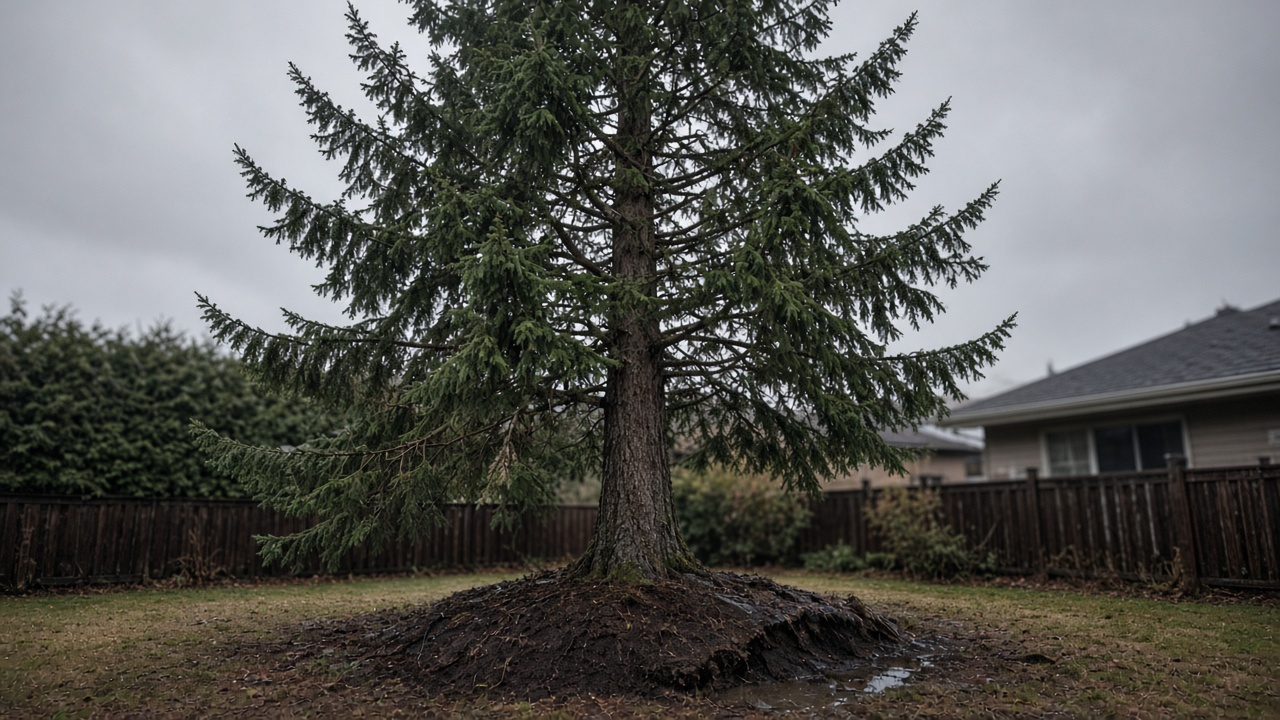
After heavy fall rain in Delta and Metro Vancouver, cracked or mounded soil at a tree's base can mean the root plate is lifting. What to check from a distance, and when to call.
Every late October in Delta, Ladner and Tsawwassen, a multi-day rain leaves the lawn spongy and a puddle by the fence. Then the soil beside a big Douglas fir, western red cedar or hemlock looks cracked, lifted or slightly mounded. The crown can still be green. From the street the tree can look unchanged. The ground under it is what to notice before the November and December southeast gales.
This is not a leaning-tree guide, and it is not a deadwood list. If the question is whether an old lean is stable or a changing lean means removal, read leaning trees before the wet season. If the worry is hanging dead limbs, start with storm-season prep. Below is the narrower job: after heavy fall rain, signs a root plate is lifting, what you can check from a distance, and when to call for an assessment, a reduction, or removal.
Why this stretch of rain matters more than one wet afternoon
A shower wets the lawn and drains. A late-October atmospheric river leaves the soil around a mature root system heavy and soft. In low Delta yards, and on fill or clay lots across Metro Vancouver, water can sit at the flare after the rain eases.
Southeast gales often peak in November and December, once that soil is saturated. A tree that was firm in August now stands in ground that grips less well, with a full evergreen crown still catching wind. The failure is often windthrow: the plate rotating out while the stem above the flare is still sound. If this rain changed the base, use the days before the next gale.
What a lifting root plate looks like from the lawn
A root plate is the mat of large roots and the soil they hold. When it lifts, look on the ground, on the side away from the lean.
Cracked or crescent-shaped soil. A fresh arc opposite the lean is the hinge. Straight shrinkage cracks usually ignore the trunk.
Mounded or lifted turf. A low mound or curled lip of sod counts if that spot was flat before this rain. A mound opposite the lean fits. A leftover garden pile usually does not.
Exposed or snapped roots. Newly visible, torn or broken roots opposite the lean are the ones in tension. Do not pull, stand on or dig them.
A new lean, or a lean that jumped. An old lean toward the light can be stable for years. One that appeared or worsened in this rain is movement. Compare it with a fence post or an earlier photo.
Standing water around the trunk. Ponding alone is common in Delta and does not prove movement. With a crack, a mound, exposed roots or a changed lean, the tree is in softer ground than in September.
Recent work in the root zone. A trench, new driveway, patio, stump grind or utility cut can sever holding roots. If that was this season and the soil is heaving, read them together. Planning the dig is covered in drainage work and the existing tree.
Why saturated soil and wind throw fir, cedar and hemlock
Douglas fir, western red cedar and western hemlock are the tall conifers we see most in Delta and Metro Vancouver. They can look healthy and still stand on a shallow plate where the water table is high or the subsoil is hard. Soft upper soil is not a deep anchor.
The crown stays a sail. Foliage stays on through winter. Rain adds weight, and a southeast gale pushes for hours. A bare maple sheds some of that sail. These conifers do not.
Wet soil loses its grip. Full pores let soil slide past roots. The wood need not be rotten. Height is the lever, and saturated ground is the slip. That is the setup the week after an atmospheric river.
The hinge is usually windward. The plate tends to lift on the side the wind comes from, opposite the new lean. A photo of only the downhill puddle can miss that crack.
Decay is separate. Mushrooms or a soft flare can mean root or butt rot, covered in mushrooms at the base. A green tree can also throw on soil grip alone. Deadwood pruning does not push a plate back down. If you have both, say so.
What is safe to check yourself from a distance
Stay on firm ground, off the mound, and out of the fall direction. If you cannot tell which way that is, step farther back.
Do not load the tree. Do not climb, shake the trunk, tie it to a deck, or hang weight to test the lean. A guy rope can finish the lift.
Do not dig or wash the flare. A shovel or hose can cut roots that are still holding. Photograph the crack as it is.
Bring an older photo. The same corner of the house, from before this rain, shows whether the lean is new.
Name the targets, then stop. House, driveway, play space, fence or car in the lean direction is why the timing matters.
Leave if it is moving. If the plate shifts, you hear roots, or the lean grows while you watch, get clear and keep people and cars out of that line.
Stay away from power lines. If the crown meets a line, do not walk in for a closer photo. Mention the line. Do not clear it.
Root-plate clues versus other fall problems
| What you are seeing | What it usually means | Next step |
|---|---|---|
| Crack or mound opposite a new or worse lean | Plate starting to lift | Stay off that side and book a look |
| Old lean, firm ground, no new cracks | Historic lean, not active windthrow | Watch it; see the leaning-tree guide |
| Mushrooms or a soft flare, soil still flat | Possible root or butt rot | Health assessment for the decay |
| Dead limbs or a crack high on the stem | Canopy or stem issue, not the plate | Storm-prep or stem assessment |
| New trench or patio, then heave | Digging cut the anchorage | Assess before more digging |
| Water only, no crack, mound or new lean | Wet flare, not proof of movement | Recheck after the next rain |
A tree can match more than one row. Name them when you call.
When a shorter crown still helps, and when it will not
Crown reduction and deadwood pruning lower the sail. If the plate is seated — firm ground, no fresh heave, an unchanged lean — taking weight off before the gales can be the right job. Cuts go back to a lateral. Topping is not reduction: a flat top leaves weak sprouts and the same roots.
Once the plate is lifting, a shorter crown is false comfort. The tree can still rotate in saturated soil. Look at the base before any wood comes off. We will say if a light reduction fits a sound tree, and we will say if it would only delay removal. A cable in the crown does not rebuild soil grip.
When to call for an assessment, a reduction or removal
Call for a tree health assessment for a new crack, a low mound, or ponding with a slight lean change, while the tree is still. A tree health report separates wet ground, a plate losing grip, and decay or stem trouble. Photos start the visit. They do not replace it.
Call about removal when a hinge crack, snapped roots and a lean that jumped in this rain point at a house, drive or play area. Tree removal, including a rigged takedown in a tight yard, is a planned job while the tree is upright. We will say if removal is ahead of the evidence.
Ask about reduction when the base is sound and the worry is wind on a healthy crown.
Check the rules before anyone cuts. In Delta, check the Tree Protection and Regulation Bylaw before removing or pruning a private tree, and do not prune or remove City trees. Start at the City of Delta trees page. Other cities differ. Our arborist reports and permits service prepares a report when one is required. We do not predict the outcome.
Visits are schedule- and weather-dependent. Soft ground and a gale both limit what a crew can do that day.
What to ask for when you call
Describe the soil and the target. You do not need a species name or a diagnosis.
- Whole-tree photo from a safe spot, trunk against the house or a fence post.
- Base photo of the crack, mound or roots, from firm ground, not from on the heave.
- An earlier photo from this fall, if you have a similar angle.
- Target photo of the roof, driveway, play area or fence in the lean direction.
- Recent work near the roots: trench, concrete, stump grinding or construction.
- Water notes: is the puddle new, and is it there a day later?
- Access notes: gates, soft lawn, and a route that avoids the crack.
- Line notes if a power or communication line is in the crown.
If you can take only one picture safely, make it the wide shot of the trunk and the disturbed soil.
Get a plan on the base before the southeast gales
Heavy rain does not condemn every fir, cedar or hemlock. It changes the question. After an atmospheric river, with November wind still ahead, mounded soil opposite the lean, snapped roots or a new lean is a base problem. Deadwood pruning will not put the plate back.
Woodpro crews include ISA-certified arborists, work fully insured, and follow WorkSafe BC practices. We can tell you whether this is an assessment, a reduction on a sound tree, a removal while it is upright, or wet ground.
Get a Free Quote, or call (778) 800-6791. You can also email a few photos of the whole tree and the base to info@woodpro.ca. We serve Delta, Ladner, Tsawwassen and communities across Metro Vancouver and the Lower Mainland.