Home / Blog / After Leaf Drop, What Does a Bare Maple Show Before Metro Vancouver's Winter Storms?
Tree Care Planning
What a Bare Maple, Birch, Cherry or Oak Shows After Late-October Leaf Drop
Woodpro Team · · ~7 min read
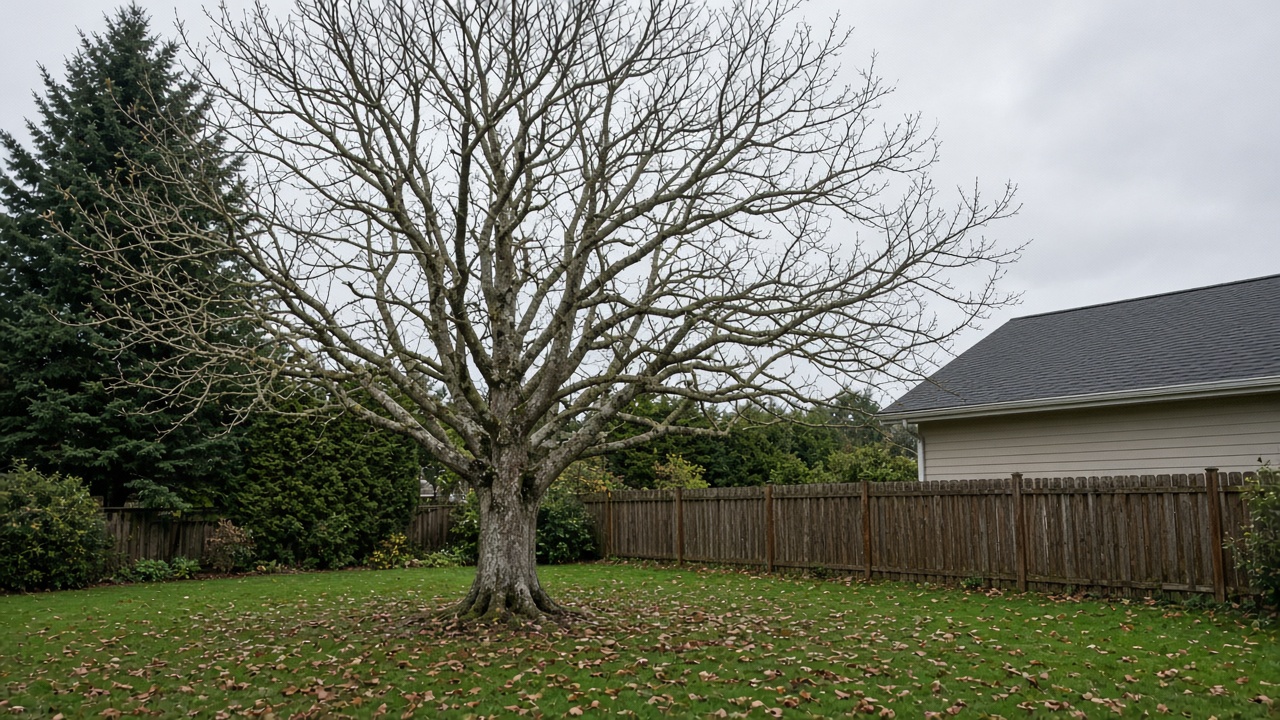
Once maples, birch, cherry and oak drop their leaves in Delta, deadwood, tight unions and roof limbs are easier to see from the ground. Why that look helps before winter storms.
Every late October in Delta, Ladner and Tsawwassen, the bigleaf maples, birch, flowering cherry and oaks finish dropping their leaves. The crown that looked solid in September is a drawing of wood against a grey sky. From the sidewalk you can see the forks and the limbs that reach the roof, just as November and December southeast gales start to matter.
This is not the wider fall health walk on roots, fungi and dieback in our fall tree health assessment. A stem that has already opened is a split trunk question. Cable bracing for weak unions and when to prune an established tree cover support and timing. Below is the narrower job: what you can notice from the ground on a bare maple, birch, cherry or oak, and why that look helps you plan pruning, cabling or removal before winter storms.
Why the wood only shows after the leaves are gone
In full leaf, a healthy crown hides the structure. A crossing limb sits inside green. A dead stub looks like a gap in the foliage. A tight fork is a dark notch you walk past. After leaf drop, the same tree is a silhouette. You are seeing the architecture the wind will load, not diagnosing decay from the sidewalk.
A bare maple has shed much of its sail. The Douglas fir or western red cedar beside it has not. That lighter sail is not a free pass. Wet wood, a heavy lateral over a bedroom, a crack at a fork and saturated soil in a low Delta yard still add up.
What you can notice without leaving the ground
Stay on the lawn. Do not climb a wet trunk, stand on a roof or pull a limb to test it. Photograph what you see. This list is not a diagnosis.
Deadwood. Grey sticks that never leafed, without the fine twigs live wood still carries. Small dead twigs are common. A limb about as thick as your arm, over a roof, drive or play space, is the one to record.
Crossing or rubbing limbs. Two branches that touch, or that will touch in wind, often with a polished patch of worn bark. That is often a pruning note, not a removal.
Tight V-unions. A narrow fork where two stems of similar size rise together, sometimes with a dark seam of included bark. Ask about support. Do not wrap the fork in rope.
Cracks. A split along a limb, or a seam at a fork. Old cracks often have rounded edges. A crack that lengthened this fall, or that shows daylight, belongs in the photos. An opening main stem is a split-trunk question.
Lean. A trunk that now tips toward the house is different from a tree that has leaned toward the light for years. Compare the bare stem with a fence post or a summer photo.
Cavities and old wounds. A hollow, a wound that never closed, or dark seepage. A cavity does not by itself mean the tree comes down. Do not probe it.
Limbs over roofs, drives and lines. Mark which branches sit over shingles, a gutter, a fence or a service drop. Do not clear them on this walk. If a limb is in a power or communication line, stay back and say so when you call.
How maple, birch, cherry and oak usually read
You do not need a species key. These are the deciduous trees we hear about most after leaf drop in Delta and across Metro Vancouver.
Maple. Heavy laterals and crowded forks are common, and a limb over the roof can look closer than it did in August. Note which stem leans.
Birch. Fine dead twigs up high are common. Peeling bark is normal, not a cavity. A large dead leader or a crack at a fork is the note that matters.
Cherry. Rubbing limbs and old heading stubs show up in a low crown. That is often a pruning plan, unless the stem is failing over the walk. A twiggy crown is not a reason to top it.
Oak. Brown leaves can hang into winter. Look through them at the large limbs. Leftover leaves are not a health problem.
Why a dormant look helps before the winter storms
November and December southeast gales are what this coast plans around. On these trees most of the leaf sail is already gone, so what remains is wood. Sorting it now is a plan, not a promise to cut. Many of these trees need nothing this winter.
Pruning. Deadwood, a rubbing pair and modest roof clearance are easier to lay out while the cuts are visible. The reason comes first. A calendar date does not. We do not top, flush-cut or lion-tail a crown by stripping inner wood and leaving tufts at the tips. If a request would do that, we will say so. See tree trimming and pruning.
Cabling. A tight V or co-dominant stems over a target can be a bracing question if the tree is worth keeping. A cable does not close a crack that is already open. Cable bracing supports a tree you are retaining.
Removal. A cavity, crack or lean that pruning and a cable will not make reasonable over a house is a removal question. Tree removal, including a rigged takedown in a tight yard, is planned while the tree is standing. We will say if that is ahead of the photos.
When the base matters too. Fungi, a buried flare or soil that heaved in the last rain are not things leaf drop shows. Mention them. A tree health report can sit beside this list.
A bare-tree note versus a different fall job
| What you are seeing | What it usually means | Next step |
|---|---|---|
| Dead sticks, or worn bark where limbs rub | Often a dormant prune | Photo them and ask |
| Tight V, tree otherwise sound | Possible support question | Look before any cable |
| Crack opening on a main fork | More than a routine note | Stay clear |
| Live limb over the roof, no crack | Clearance planning | Do not cut it yourself |
| Birch peel, or a few oak leaves left | Not a defect by itself | Do not book work for that |
| Cavity plus a lean at the house | Keep-or-remove question | Wide photo and a site look |
A tree can match more than one row. Name them when you call.
What to leave alone on a wet afternoon
Looking is the useful part. Cutting from a wet ladder is where people get hurt and trees get topped.
Do not climb, and do not saw a limb over the roof from a ladder or a pole tool unless you already know the hinge and the drop.
Do not tie a rope from a suspect fork to a fence to hold it for winter. That can load the union a new way.
Do not top the crown to make it look smaller. The stubs sprout weakly, and the bad union remains.
Leave wires alone. Photograph from across the yard. Clearing a power or communication line is not a homeowner job, and it is not automatically ours. We will say when the utility should hear first.
Do not probe a cavity, strip bark or dig at the flare.
Bylaws differ, and a bare limb is not automatically exempt
Cities here do not share one tree rule. In Delta, check the Tree Protection and Regulation Bylaw before removing or substantially pruning a private tree, and do not prune or remove City trees. Start at the City of Delta trees page. Surrey, Richmond, Burnaby, Vancouver and the rest differ. Arborist reports and permits is how we prepare a report when a city asks for one. We do not predict the outcome or the timeline.
Deadwood is not automatically exempt. If the tree is on a strata lot or a shared boundary, say so. A visit, and any storm response, is schedule- and weather-dependent.
What to ask for when you call
You do not need a species name. Describe the bare tree and the target.
- Whole-tree photo from across the yard, trunk against the house or a fence.
- Union or defect photo of a tight V, crack, cavity, rub or dead stub, from the ground.
- Target photo of the roof, drive, play space or fence in line with the limb.
- Line note if a wire is in the crown. Stay back.
- A summer photo, if you have a similar angle.
- City and ownership: Delta, Surrey, a strata, or a possible boulevard tree.
- The hope: deadwood, roof clearance, keep the tree, or a removal quote. Unsure is a fine answer.
One safe picture is enough to start: the wide shot of the whole bare tree.
Plan the work while the crown is still a drawing
Leaf drop does not mean the tree is failing, or that every maple needs work before December. It means the structure is readable. Those notes become a prune, a cable, a tree to watch or a removal only after someone looks at the real tree.
Woodpro crews include ISA-certified arborists, work fully insured, and follow WorkSafe BC practices. We can tell you whether this bare crown is a dormant prune, a bracing question, a removal, or a tree to leave until spring.
Get a Free Quote, or call (778) 800-6791. You can also email a few photos of the whole bare tree and the limbs you noticed to info@woodpro.ca. We serve Delta, Ladner, Tsawwassen and communities across Metro Vancouver and the Lower Mainland.