Home / Blog / Trees Into the Power Lines? Fall Clearance Before Metro Vancouver Storm Season
Tree Trimming & Pruning
When Branches Reach the Hydro Lines: What to Do Before Fall Storms in Metro Vancouver
Woodpro Team · · ~7 min read
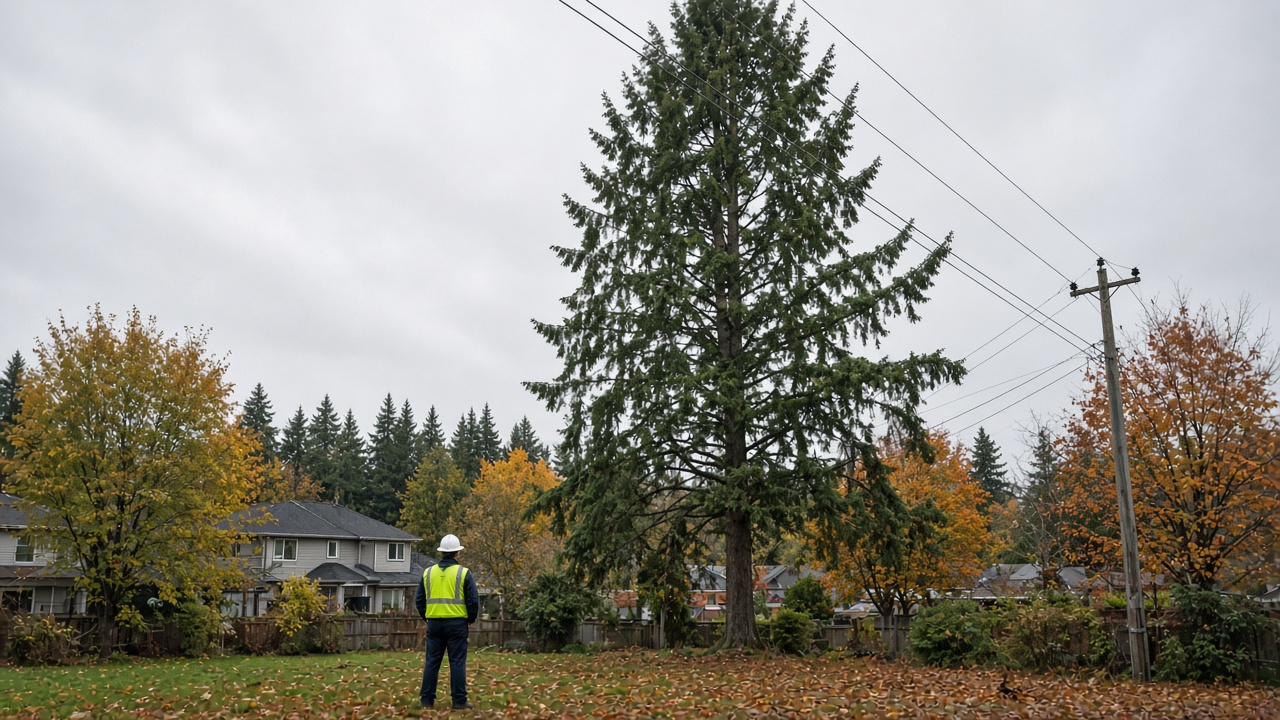
Seeing branches near hydro lines before fall storms? Learn when to call the utility vs an arborist for safe power-line tree clearance in Metro Vancouver.
Early October is when a lot of Metro Vancouver homeowners finally look up — and notice a maple, alder or Douglas-fir that has crept into the overhead lines. A branch that looked fine in July can sit much closer after a summer of growth, and fall storms are when that gap gets tested.
This is not the same problem as limbs sitting on a roof or gutters. Clearance over the house is about your building and your gutters. Clearance near power and utility lines is about energized conductors, and the work belongs with people who know how to stay clear of them. If branches are through the canopy of the lines, rubbing a conductor, or a tree is leaning toward the span, treat it as a utility-and-arborist problem — not a weekend ladder job.
Why fall is the time to deal with trees near the lines
Wet-season wind and rain hit the Lower Mainland hard. Trees near lines fail in ways homeowners feel immediately: a limb on the conductor, a partial outage, or a tree that cannot be cut until the utility has made the span safe to work around.
- Summer growth closes the gap. What looked like “close but fine” in spring can be contact risk by October after a summer flush of new wood.
- Storm loading changes everything. Rain-soaked foliage and wind push long limbs farther toward a span than they sit on a calm day.
- Post-storm contact is harder to fix. Once a limb is on a live line, tree work usually waits on utility response. Clearing the risk ahead of time is simpler.
- Schedules fill once the first big storms hit. An assessment now gives you more choice on timing.
For a broader look at reducing storm risk on the property — not just at the lines — see our guide to fall storm prep and deadwood.
What to watch for from the ground
You do not need to climb anything to spot trouble. From a safe distance on the ground, look for:
- Lines through the canopy — conductors passing through foliage, not cleanly beside or above it
- Branches rubbing or resting on a conductor — even light contact can worsen in wind
- A lean toward the span, especially after wet soil or root disturbance
- Dead or broken wood that could drop onto conductors — related to, but not the same as, widowmaker limbs over a yard or roof
- Recent storm damage that moved limbs closer to the lines than before
If you see sparks, hear arcing, smell burning, or see a limb fully on a line, stay well clear, keep others away, and contact the utility’s emergency line for your area. Do not try to move the wood yourself.
DIY vs arborist vs call the utility
Utility companies set their own vegetation and clearance rules, and those rules vary by line type and location. What follows is a practical way to think about who to involve — not a substitute for the utility’s own guidance.
| Situation | Who to involve | Why |
|---|---|---|
| Branches near or into energized lines; you want to prune them yourself | Do not DIY | Contact with energized conductors can kill. Ladders, pole saws and aluminum tools do not belong near live lines |
| Tree work needed and lines are involved or very close | Arborist + utility as needed | The arborist plans the tree work; the utility decides when their crews must make the span safe or handle line-side vegetation |
| Limb already on a live line, arcing, or outage | Utility first | Energized-line emergencies are a utility response — then the arborist can clear the tree once it is safe to work |
| Clearance over roof/gutters only, no utility involvement | Arborist | That is roof clearance pruning, a different job |
| Tree is failing and would hit the lines if it came down | Arborist assessment; utility if the span is at risk | May be pruning, sectional removal, or full removal with a plan that protects the conductors |
When in doubt, do not cut. Call an arborist for a ground assessment, and involve the utility whenever the work would put people or equipment near energized conductors.
How an arborist approaches power-line clearance
Woodpro’s tree trimming & pruning service includes clearance work around structures and utilities. On a typical residential job near overhead lines, an ISA-certified arborist will:
- Assess from the ground first — species, lean, deadwood, and how close the crown sits to the span.
- Decide prune vs remove. Directional pruning and deadwood removal can restore a safe gap; structure, lean or decay may mean removal is the safer long-term answer.
- Coordinate with the utility when required. If the work cannot be done safely with lines energized, the utility’s process for protecting the span comes first. Rules vary — the arborist follows that process rather than cutting corners around it.
- Plan drop zones and rigging. Pieces are lowered and controlled so nothing is thrown toward conductors, fences or the house. Tight yards sometimes need a crane-assisted approach.
- Clean up with chipping and haul-away through our debris removal service. After a storm already put wood on the ground, see our post-storm cleanup guide.
If a municipal permit is part of removing a protected tree, Woodpro’s arborist reports & permits team can handle the documentation alongside the field work.
Pruning or removal: how the call gets made
Not every tree near a line has to come down.
Pruning is often enough when the tree is otherwise healthy, the problem is a few long limbs or a crowded crown edge, and a skilled crew can create lasting clearance without topping. Topping — cutting the top off and leaving stubs — creates weak re-growth and usually makes the next storm season worse.
Removal is the better conversation when the tree leans toward the lines, the main stem is cracked or decayed, a large part of the crown is already through the span, or storm damage keeps bringing wood back into the conductors.
An on-site assessment separates those two paths. Photos help for a first quote; a visit confirms lean, roots and attachment the camera can miss.
What not to do
- Do not prune near energized lines yourself — including rented pole saws, “just the tips” cuts, or climbing beside conductors.
- Do not assume a neighbour’s tree is yours to cut where it crosses the property line — talk to them first, then involve the right professionals.
- Do not wait for the first outage if you already see contact risk.
- Do not confuse roof clearance with line clearance. Limbs on shingles and gutters are a different scope; see our roof clearance pruning post for that job.
What to send when you request a quote
- Address and municipality (Delta, Surrey, Vancouver, Richmond, and the rest of the Lower Mainland)
- Clear photos of the tree and the span — from the ground, showing how close the crown sits to the lines
- What you noticed: rubbing, lean, dead limbs, post-storm movement, or lines through the canopy
- Whether the tree is on your lot or appears shared / on the neighbour’s side
- Access notes: narrow side yard, locked gate, parked vehicles under the drop zone
- Any utility contact you’ve already made (ticket number or date is helpful if you have one — not required)
Pricing depends on tree size, proximity to the lines, access, whether the utility must be involved, and whether the job is pruning or removal. The fastest way to a clear number is to request a free quote.
One crew from assessment to cleanup
Woodpro handles the tree side of the job: assessment, trimming & pruning, removal when needed, permit support, and full debris cleanup. Crews include ISA-certified arborists, work fully insured, and follow WorkSafe BC practices. When energized lines are involved, we work within the utility’s rules — we do not ask homeowners to DIY the dangerous part.
Trees reaching the hydro lines this fall?
Get a ground assessment before the wet, windy stretch fills every calendar on the Lower Mainland.
Get a Free Quote, or call (778) 800-6791. You can also email a few photos of the tree and the lines to info@woodpro.ca.
Woodpro Tree Services is based in Delta BC (North Delta, South Delta & Ladner) and serves Metro Vancouver and the Lower Mainland with tree trimming & pruning, tree removal, debris removal and arborist reports & permits. Scheduling depends on weather, access, utility coordination when required, and the current calendar.